They are a startling sight. Black and gold striped bodies hanging casually on the linen curtains on the French windows. I don’t know how they get in. This morning I found two, far apart. I take a glass tumbler and capture them. Today was tricky, because I had to capture one, carefully place it on the table while I got the other. The second wasp was agitated, so I had to wait until it stopped buzzing and trying to escape. Then I quickly released them into the garden.
It is November, but the bees are still finding their way to the flowers, and the wasps are finding their way into the house. I don’t know ow if they built a nest in, say, the attic space. I don’t think I have an attic; more a crawl space. I used to worry squirrels got in, when I heard the sound of chairs falling, which I was once told is the noise a trapped squirrel in the attic makes. I like my nature outside, I confess. I will walk out the spiders, but swat the mosquitoes.
Then there are the ants. Ants have been making their presence known in streams of military lines which I fight off. They come in all sizes. But I no longer use traps, as I think that what my senior might have licked to damage her stomach. She is on the mend, and I place the cat food in saucers of water. I do the same for my sugar and honey bowls.
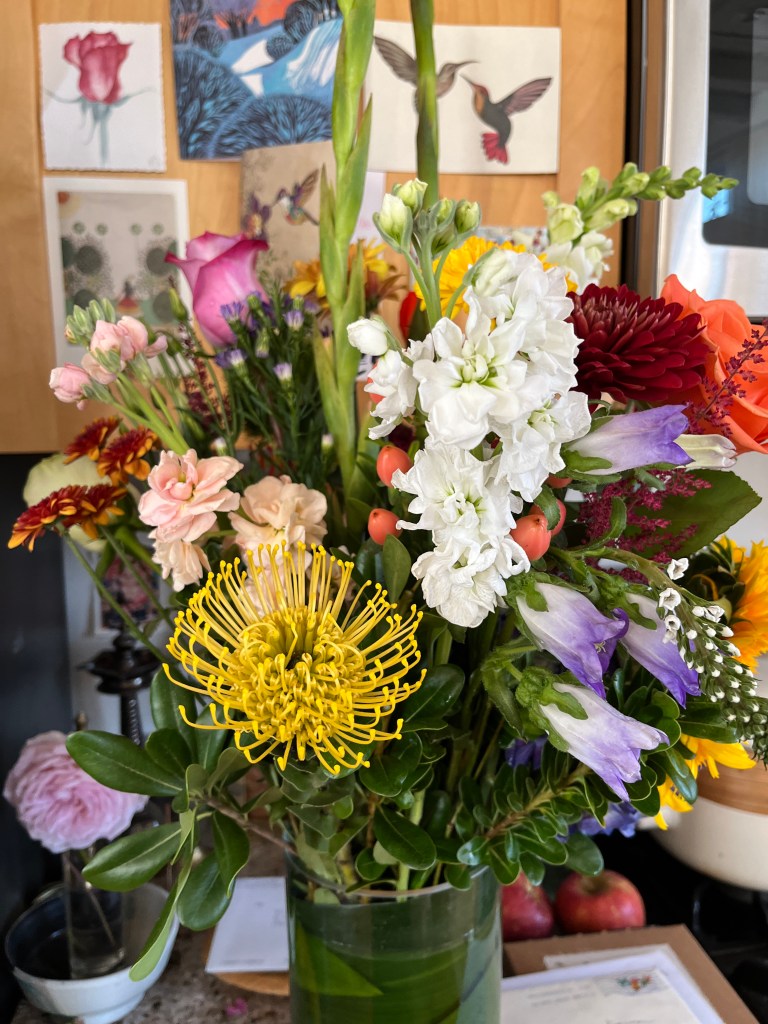
Outside, as I write, the leaves are a brilliant mix of orange and yellow, and the blue sky is puffy with clouds. Robins have been eating the last of the wild berries, and the monument is already strung up with holiday lights. I am not sure why the wasps are active, and I hope they will quietly move. Maybe they came in with the flowers I received from my family. Maybe they hitched a ride. In any case, they are set free, back to nature, to build their nests, grow families.
One of my favorite stories is “Misery” by Chekhov. It is a simple story of a cab driver who ferries rich Russians from one party to another, or takes them home. In this short story, the driver has learned of his son’s death. In vain, he tries to speak of his loss to his passengers. One by one, they reject him, demanding he drive fast, get them to where they are going. At the end of his shift, the driver pours his heart out to his horse, the only one who will listen patiently. As I write theese sentences, my eyes fill with tears, because this story more than others touches my heart with truth. Despair is a lonely thing. Grief is a private matter.
When my father died, I heard the news on the phone, as I hung on to the receiver as my sister-in-law drove through the night to reach my mother, my brother ahead of them in his car. After hanging up the phone, I sat still on my sofa that November night, shocked to my core. I forced myself to arrange for a flight home in the morning. But then I sat still. After an hour or hours, I thought, I must call someone. But who? Sadly, the one person I thought of, an acquaintance who lived only a doors away, later told me that she decided, on seeing my name flash on her phone, not to pick up. Who knows why? It was not yet midnight, but maybe it was. I had not called anyone so late at night in decades. I did not call anyone else.
The next day, I went to the grocery store to pick up snacks for the flight home. I think I just needed to do something. Someone I hardly knew noticed something in my face as we spoke, and asked what was wrong. Careful now with my grief, I said nothing. And weirdly, I told the cashier, who I knew from being a frequent customer, but what could he do but stammer a sympathy, and turn to the next person in line.
Grief is a fragile thing. Needing cat care while I was away, I let other neighbors know, and received sympathy, a few hugs.
I decided to email two people at the arts center which also served as my landlord, thinking that as they too lived nearby, I might be able to share my misery. Again, no one replied, no one phoned, though one did later email his brief condolences. They were young people, far younger than me, and I didn’t really belong in their world; perhaps they simply did not know how to react. Had I reached out to the university I taught at, my needs might have been met better. What did I want ? Acknowledgement. Sympathy. My father would have recognized I was searching for the impossible: meaning. Maybe my emails landed in their spam folder. But I thought I needed to turn to something bigger than myself, an institution that could hold my grief, direct its flow, comfort me. I did not really need an institution or acquaintances. What I really needed was a horse. What I really needed was my friends.
Finally, I went to the radio station where I volunteer and told the staff, all men who barely knew me, who akwardly offered sympathy. But what was important was they held space for me. They recognized something significant in the moment. Perhaps, being closer to my age, they recognized a need I could barely express. Again my eyes fill with tears as I type this, plus a pressure builds in my chest. The ache of lonliness can be severe. The ache of powerlessness in the face of death.
At the airport, as I ate breakfast, I listened to a couple sitting next to me, and I was filled with the urge to say something. I didn’t. How could they eat their eggs so calmly? We held the funeral that weekend. I returned to my apartment in a town I had lived in for only four years.
I think of the millions who have died due to COVId-19, to the shock of loss that greets families each day, each hour. I cannot compherend the number. I distract myself with stories in the newspaper, distract myself with zoom lectures. I wear my mask, and keep to myself, generally. Yet how will this misery play out?
I began to write this two years ago, and still work on it. I recognize I am still hurt by the rejection I received from the people I had initially turned to in my grief, and want to strike back, though they will never read this. I think in times of abject misery, grief, one needs comrades to embrace, to talk until the story is told, complete. Of course I should have phoned my close friends who would have taken my call, but I wonder if my mind was blocking my logic. Did I turn to the very people I might have known would not support me in the blind hope that they they might defy my expectations? Was I playing a complicated game of denying myself comfort in this most dismal moment? I was not a cab driver in 19th century Russia.
What I have done is weave myself a net these past few years as I try to make a life in my new home. I have now lived here longer in one place than any other place. I choose with care, especially in these times of uncertain pandemic, where to spend my time, and with whom. I choose more carefully, or try to.
I realized that to create community, I needed to recognize my own limitations. I still let shyness get the better of me, say no more often than yes. I still sabotage myself, not act in my best interest. I like to think I am better at it, though, at life, I my fumbling and yearnings. Yet maybe I am aware if how fragile our happiness is, how momentary.
My cat purrs, stretches and resettles herself on my thigh. Her purr is as loud as a horse.
After you read this, go hug someone you love, and hold them close. Let your tears flow, and know it is all important, all of it.




 Indira Ganesan