Category Archives: writing

on writing, rewriting, & taking notes

Books, Cheer, New Year

Indira Ganesan, streak of sunlight, 2013

Indira Ganesan, streak of sunlight, 2013

Dancing with joy at this lovely starred Kirkus review for As Sweet As Honey:

http://www.kirkusreviews.com/book-reviews/indira-ganesan/sweet-as-honey/ (review text below)

Reading The Marriage Plot; When I Was Cool; Lake People; & Tree Barking!  But, oh, I saw the “Downton Abbey” season three premiere  yesterday, & down the slippery BBC slope I go!  Those gorgeous clothes, actors, moments!

Ah, Welcome January!

From Kirkus Book Reviews:

  • Online Publish Date: January 6, 2013
    Publisher:Knopf
    Pages: 288
    Price ( Hardcover ): $25.95
    Publication Date: February 15, 2013
    ISBN ( Hardcover ): 978-0-307-96044-3
    Category: Fiction

The imaginary Indian coastal island of Pi, where Ganesan has set her previous fiction (Inheritance, 1998, etc.), works beautifully as the setting for this East Asian homage to To the Lighthouse, both the nostalgic recreation of a lost perfect moment and an exploration into Woolf’s “thousand shapes” of love.

The novel opens with a wedding and a death almost in the same breath. After a brief but romantic courtship, 6-foot, 28-year-old Meterling (thoroughly East Asian despite her eccentric German name) receives permission from her Hindu family to marry Archer, a dapper 4 foot-7-inch Englishman in his 40s. During their first wedding dance, he suffers a fatal coronary. Meterling is naturally heartbroken; she is also pregnant. The narrator of the aftermath, Meterling’s much younger cousin Mina, lives with a passel of cousins, aunts and uncles in her grandmother’s household of joyous pandemonium, which is not unlike the genteel chaos of Woolf’s Ramsays; coincidentally, Mina’s is a family of well-read Anglophiles, not unaware that Pi is a little like Prospero’s enchanted island. Looking back from her own adulthood, Mina describes growing up in an innocent but not unsophisticated world in which people really do take care of each other and where what is meant to be happens. So her family accepts the scandalous fact that Meterling had sex before marriage and adores the resulting baby, Oscar. But Western influence is unavoidable. Mina lives with her grandmother since her parents are getting Ph.D.s at Princeton, and eventually, she ends up in America. Yet Mina still manages to tell the story of Meterling’s unexpected second romance and marriage to Archer’s cousin Simon, with whom she moves to England. The novel is masterful at exploring the difficulty of cultural identity and integration. There’s also a bit of magical realism in the shape of a ghost. But ultimately, this is a novel about the many permutations of both love and family.

Despite some slightly strained plot twists, the characters’ genuine charm and the girlish, witty energy of the storytelling are irresistible.


 

Small Times Life

IMG_0605

Indira Ganesan, Tulip with Effect, 2012

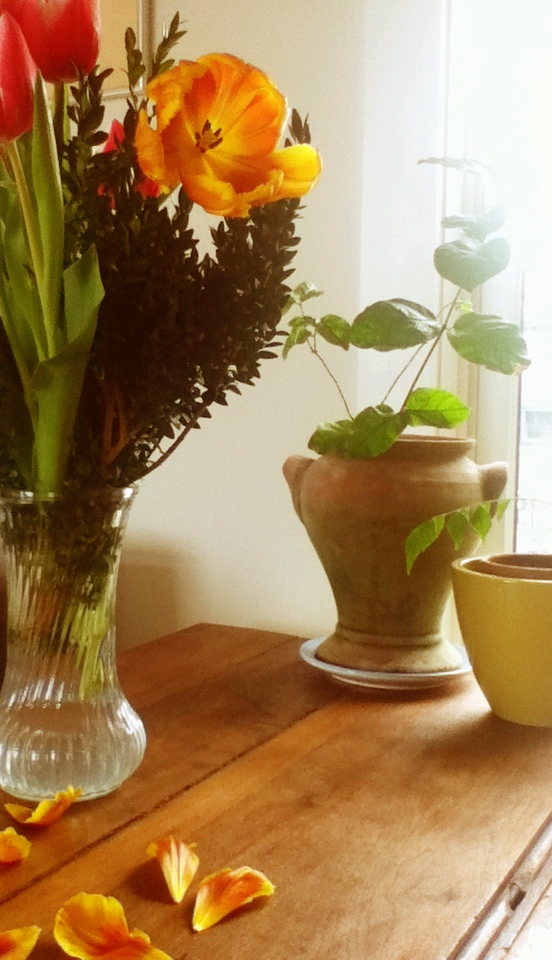
One of the pleasures in small time life, as well as living in a small town, is locating a local florist.  I’m lucky because our florists are both sophisticated and kind.  If on a winter day I wander in, and all that is on my mind are tulips, I’ll get tulips and boxwood, which I hurry home to place in a vase.

IMG_0604

Indira Ganesan, Simple Black and White, 2012

Later, I take iphotos.  A friend of mine, a photographer, uses a Leica, because she finds in it the beauty I find in an Olivetti.  She also uses her Leica to take photographs, whereas I merely admire old typewriters.

IMG_0606

Indira Ganesan, Tulips & Jasmine, 2012

I’ve rearranged my work space, hoping in the process to find a writing process that will stick.  I have a prized office, but I am going to make it into a library and meditation space.  I’ve moved my desk upstairs, where my perspective has more depth.  I know I am trying to recreate a design that took me two years to achieve in Boulder, where I rearranged furniture constantly in order to let the novel write itself.  It is an exercise in futility, but I think it has some purpose.  I need time to sit comfortably–indeed, find my comfortable seat.  One has to trust the environment implicitly to get to work.  Moving is arduous.  One feels guilty in leaving behind friends, one wonders why it was even necessary, why the hand was forced for economics, and then one wonders what it is one is trying to achieve.  Some can write anywhere, and so one feels guilty that one is squandering a space of time.  Then one looks up, sees the time, and gets to work.  The  flowers are essential, crucial.  Our lives are delicate and strong.  I don’t know how to end this piece without acknowledging the terrible loss suffered by parents and family and friends in Connecticut today.  I don’t know how we bring ourselves to this moment.

I advocate for banning guns.

An argument from Bill Moyers: http://billmoyers.com/segment/bill-moyers-essay-living-under-the-gun/

Ravi Shankar


English: Ravi Shankar performs in Delhi with h... English: Ravi Shankar performs in Delhi with his daughter Anoushka in March 2009 (Photo credit: Wikipedia)


English: Master of Sitar, Ravi Shankar. Deutsc... English: Master of Sitar, Ravi Shankar. Deutsch: Ravi Shankar, Meister der Sitar. (Photo credit: Wikipedia)


It is with a heavy heart that I write a post today.  Pandit Ravi Shankar passed away yesterday at 4pm in La Jolla, CA.  He was 92.


I opened the online New York Times early  this morning, simply out of a nostalgia for the days when I would begin my day with its news, instead of say, writing or checking email.  The announcement caught me by surprise, and after reading the article and looking at The Guardian,  I posted a video of a concert of his I found on YouTube, a gentle nine-minute piece rom a raga, “Anandi Kalyan.”


The process of celebrating, honoring, and grieving a great or famous soul’s passing is a curious one.  When John Lennon died, I found out with a clutch to my heart as I slowly realized the radio was playing song after Beatles song.  We who listened to WNEW-FM that night listened along with –was it Vince Scelscia’s?– shock.  When Michael Jackson died, so far before his time, I heard it on the radio in the car somewhere.  I live far from a city now, so of course, I did not hear Ravi Shankar’s sitar on the radio this morning, though I tried.


All day, I went about the daily activities, including a visit to the dentist, but like the stricken character in Chekov’s story, “Misery,” to whom could I speak to of my grief?  Zakir Hussein said that Panditji has gone to join the gods in heaven with whom he belongs.  I suspect there are hundreds of people right now, perhaps thousands, playing his music and remembering.  I was lucky enough to see him play in Boston with his daughter Anuoshka with my brother and soon-to-be sister-in-law, and I don’t think we could have clapped enough or hard.


Let’s keep listening, keep clapping.  He leaves us his daughters as his legacy; he leaves us his music.  He leaves us wanting more.


~


Raga Bhimpalasi (live at Monterey): http://youtu.be/LMRxDY43YtQ


Gat Kirwani:  http://youtu.be/ZYlPcbNAPH8


With Philip Glass, from Passages:  http://youtu.be/ugIbmTKrcHc