Author Archives: indiraganesan

Unknown's avatar

About indiraganesan

Writer. As Sweet As Honey:A Novel (NY: Alfred A. Knopf), February, 2013 Inheritance: A Novel (NY: Knopf), 1998 The Journey: A Novel (NY:Knopf), 1990 All available from Vintage & Beacon Press

Every Day the Hummingbird

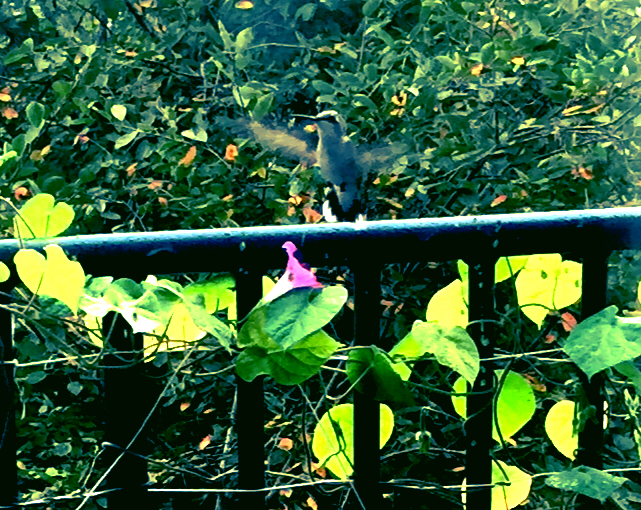
Most every day this summer, a hummingbird visits the balcony, sometimes twice, sipping from the salvias. It has a tweet that I’ve learned to distinguish. Often, after sipping, it will hover in front of the window, as if to say hello, or perhaps see if there is more food available within. this never fails to delight. The cats, though, watch without interest, which interests me. The thrum of its wings, that distinct sound of a wooden chair scraping a wooden floor, or a distint helicopter lets me know it is near. Here, it comes again.

Indira Ganesan, Hummingbird Visit, 2019

A call from the Earth who calls when we cannot or will not hear

Indira Ganesan, droplets, June 2019

Two things happened this last week that moved me considerably, the week that is that is not defined by Julian.  First, Toni Morrison passed, transitioned as Nikki Giovanni said in an interview with the BBC, and our hearts, those of us who not only adored her work, but looked to her for guidance, spilled open.  She transitioned, said Nikki Giovanni, and she is still with us.  Toni Morrison not only gave us story after story which blossomed into poetry but clearly, strongly, spoke out against, because she recognized it for what it was, and how persuasive it is, the horror of white supremacy.  

And Jorie Graham came to speak at the local arts center in Provincetown.  She spoke and read, and made the world stand still for an instant as we listened to poetry.  Like Toni Morrison, Jorie Graham looks at life in its face, and does not turn away.  She does not serve it to us neat on a plate with a platitude about how things will get better.  Her poems, incantations of sense and sensibility, are like clear drops of water steadily dripping onto a plate that we did not know needed to be filled.

Poetry moves us, and it moves us best when we forget about ourselves, and pay attention to something much bigger. I have not learned this completely, but remember, when I read, and when I write in moments of stillness, broken by a horse’s neigh, the passing truck, the invisible breath of my cat asleep on the desk.  Something tumbles down now, the cat shifts and sighs, and the horse cries again.  

The Key Reporter – In the Months of My Son’s Recovery: Poems

The Key Reporter – In the Months of My Son’s Recovery: Poems
— Read on www.keyreporter.org/BookReviews/LifeOfTheMind/Details/2756.html

In the Months of My Son’s Recovery: Poems

Kate Daniels. Louisiana State Press, 2019. 105 pages. $19.91.

By Indira Ganesan 

Kate Daniels new book of poems is an incandescent exploration of a woman’s rage and a mother’s fury, and the necessary acceptance of a life that includes contradiction. In the Months of my Son’s Recoveryis an ode to menopause, to addiction, and a search for meaning in a crazed world. From the title of her opening poem, “Her Barbaric Yawp,” referencing Whitman, she sings in awe of “the aging Female Body”:


Young,

Clad all over in tight, unwrinkled skin, not yet

Stretched out or sagging, she was a pleasure

To ogle…so we gawked and gaped….

…. Well, that’s all decades in the past. Now,

There’s this flowing away…

And eating more salads, giving up

Hard cheese, or taking on red wine,

Even adding extra sessions of Pilates

Won‘t do a goddamn thing to change it.

Yet to quote fragments of her poems is really to do a disservice, as the beauty of a Daniels poem is in exactly how the words are chosen, and how they come together, cut with an Exacto knife, finessed with a broad scope of a poet’s tools. These are not pretty, decorous poems, but hard and harsh stares at reality, and breath-taking in their vigor and wisdom. Look at how the line breaks in each poem emphasize and underscore, how the humor is turned to irony, to sad profundity. To read only fragments (and fragments are what I will offer here) is to hear a stifled scream, a half laugh, a chocked back cough. Thankfully, a review only points the way to the work itself. 

Kate Daniel’s book is divided into three parts, and the first is “Her.” From the aging body, the astonishment of a body’s betrayal, and worse, society’s betrayal, we go back in time to the annihilating ways in which young girls try to control their bodies and apologize for their minds as the author takes in student conferences (“This is probably wrong, she says. Probably/stupid, twisting her hair, and shrinking back”) to where as an experiment, the narrator, fresh out of college herself, undertakes to challenge the Male Gaze. Recalling her impulse to turn an assault into something poetic (because that was how we justified the world then) the narrator, in a sweet reversal, reading Frank O’Hara, ferries to Fire Island, where the Gaze flickers “neither dismissive nor predatory—nothing more than one person taking casual note of another.”

The next set of poems is called “The Addict’s Mother.” Into the mix of the ungainly beauty of an aging female body comes a child who has given himself to heroin addiction. Now come the sharp, blunt realities of a son who will steal a family car to trade for drugs, whose path of self-destruction can only make a mother look at herself to read the addiction that might have lain hidden. The mother character, who is an amalgamation of many mother, not just the poet herself, tries to find the meaning in the madness of bipolarity, or what Keats called negative capability. 

The final parts offer the subject of recovery. Reading Thomas Jefferson’s biography gives the author solace and pause, opening up complexities that are ingrained in American life. She… 


Can’t help drawing back at how he lived in two minds

Because he was of two minds like a person

With old-time Manic depression: the slaveholder

and Democrat, the tranquil hilltop of Monticello,

And the ringing cobblestones of Paris, France. The White

Wife, and the concubine: enslaved and black…

Daniels segues neatly into the birth of a son who carries the memories of genes and ancestors, how their tribulations and addictions are brought to bear on the present. “Even then, two minds circulated inside him” she says of her baby. Later, Daniels begins to reflect on how families cope with life-threatening situations (thank goodness for poets to render such words with sublimity!), ending with a poem I want to quote in its entirety, but feel, rather, you must read for yourselves. It is called “Yes,” and brings this heart-enlarging book to a wonderous close.  

Novelist Indira Ganesan was inducted into Phi Beta Kappa at Vassar College in 1982. Her books include The Journey (Alfred A. Knopf, 1990), Inheritance (Alfred A. Knopf, 1998) and As Sweet As Honey (Alfred A. Knopf, 2013).


(Posted on 8/1/2019 )